
Why wards matter
A ward is an "eye" on the map: it shows what is happening in an area you can't currently see. Dota 2 has a fog of war, and without vision you play blind — you don't know where the enemy is, where a gank will come from, or whether Roshan is up. If you're still learning the basics, start with the getting started in Dota 2 guide — and wards are exactly what turns guesses into knowledge, rather than a chore "supports do for show".
Good vision saves lives and time: you die to surprise ganks less, farm more safely and enter fights understanding the enemy's spread. The team that sees the map almost always sets the pace.
Observer vs sentry
There are two ward types, and they solve different problems. Confusing them is a classic beginner mistake.
| Ward type | What it does |
|---|---|
| Observer | Gives normal vision of an area — you see what happens there |
| Sentry | Gives True Sight — reveals invisible units and enemy wards, but no vision on its own |
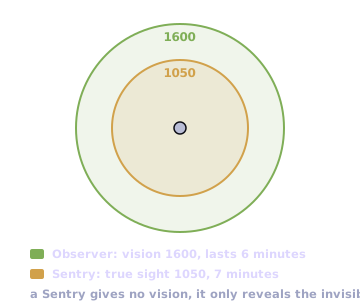
Simple formula: observers to see the map, sentries to catch invisible units and clear enemy vision. They're often placed together: an observer opens the area, and a sentry nearby protects it from dewarding and lights up invisible heroes. Observers are free, but the shop holds no more than four and restocks one every 135 seconds; a sentry costs 50 gold, with a stock of eight and a 70-second restock. An observer lasts 6 minutes, a sentry 7. The radii differ too: an observer gives vision in 1600, while a sentry's true sight covers only 1050, so sentries go closer to the spot you are checking. Either ward can be planted up to 500 away from your hero. That is why consumables are planned, not spent at random.
Where and when to ward
Exact "top spots" change with every major patch and map rework, so memorizing coordinates is pointless. What matters is the principles — they don't go stale:
- A ward should show a threat in advance. Place it where gankers come from — lane approaches and jungle exits. Vision over an empty spot is wasted.
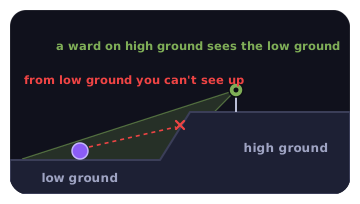
- Height decides who sees whom. A ward's vision radius is always the same — 1600. But high ground sees down, while from below you see nothing until you climb. So a ward up high covers the whole hollow below and stays unnoticed, while a low one is easy to find and clear.
- Shift vision as the game moves. Early — defensive vision around lanes and runes. Mid and late — around key objectives: Roshan, important jungle entrances, future fight zones. More on Roshan in the Roshan in Dota 2 guide.
- Think about the goal, not the habit. Before placing a ward, ask: what do I want to see with it? Protect farm, light up a gank, control an objective — every ward should have a job.
A defensive ward covers your farm zone and lanes. An aggressive one sits deeper on the enemy's half and helps catch them and set up ganks. When you're ahead, push vision toward the enemy; when behind, pull it closer to yourself so you stop dying.
Vision control and dewarding
Seeing the map is half the job. The other half is denying the enemy sight. That's vision control, and removing enemy wards is called dewarding.
- Sentry + attack. A sentry reveals the enemy observer, after which you can destroy it. The "drop a sentry, kill the ward" combo blinds the enemy in a key area.
- Deward before an objective. Before going for Roshan or a key fight, it pays to clear enemy vision — then they don't see what you're planning.
- Protect your own wards too. If you placed a positionally expensive ward, cover it with a sentry so the enemy can't clear it in seconds.
Vision control ties directly into how safely you farm and how confidently you enter fights. How farm becomes an advantage is in the farming and last-hitting and GPM and XPM guides, while who you even want to fight is set by the draft and pick-ban.
Vision around Roshan and the Tormentor
Objectives have their own vision rules, and it pays to know them before you carry wards there:
- You can't see into Roshan's pit. The entrance to both pits is lined with vision blockers: a ward or a hero outside can't see what happens inside. Since patch 7.41c flying vision can't see in either — Clockwerk during Jetpack, Night Stalker during Dark Ascension, Treant Protector's Eyes in the Forest. Wards can't be placed inside the pit, so they go on the approaches.
- Watch the live pit. By day Roshan is in the top pit, at night in the bottom one, and before 15:00 he never leaves the top. Vision on an empty pit is almost useless — details in the Roshan in Dota 2 guide.
- The Tormentor shows itself. Its pit gates are visible through the fog of war, so you need a ward for the approaches, not for the timer: since patch 7.41 three stairs lead down to the Tormentor's low ground — from the Lotus Pool, from the lane and from the high ground with the Twin Gate.
- Watchers are free vision. Watchers are neutral vision points on the map: stand next to one and a second later it lights up the area for your team. But since patch 7.40 its night radius is only 450, so at night it replaces a ward far worse than by day.
Common warding mistakes
These mistakes show up at every rank — and fixing them improves your game fastest:
- Wards pile up in the inventory. An unplaced ward does nothing. When stock is back, it's time to place it, not hoard it "for later".
- Vision placed out of habit. The same spot every game is predictable, and the enemy quickly dewards it. Adapt to how the match goes.
- Ignoring dewarding. Teams often place their own wards but never clear the enemy's — and the enemy calmly watches their moves. A sentry at the right moment decides it.
- "Vision is supports-only". When all five think about the map, there are far fewer team ganks. Cores and mid can drop a ward on the way too.
If the enemy has the vision and you keep dying to ganks, a calm head helps — that's the how not to tilt guide.

